

How Guardrail Type and Layout Influence Forklift and Pedestrian Behaviour in Industrial Facilities

In industrial environments, safety isn't just about installing barriers - it's about how those barriers shape behaviour. The type of guardrail selected and how it's positioned within a facility directly influences how forklifts move, how pedestrians navigate spaces, and how risks are perceived in real time. When chosen and designed correctly, guardrail systems don't just separate - they guide, control, and reinforce safer decision-making across the entire facility.
How Guardrail Layouts Influence Movement
The most effective safety barrier system layouts make the safe path the path of least resistance. Guardrail installations installed purely for compliance may pass an audit but typically fail under operational stress.
Many industrial facilities treat compliance as a finish line rather than a foundation. This reactive approach can lead to:
- Insufficient pedestrian walkways;
- Poorly planned access points; and
- Incorrectly placed equipment.
Guardrails are active design elements that influence movement patterns. When guardrail system layouts are thoughtfully designed, they serve as visual cues that map out vehicle routes, segregate pedestrian zones, and highlight intersections or high-risk zones.
It's important to remember that:
- People will take shortcuts if the layout feels inefficient;
- Vehicle operators will optimise for throughput, sometimes at the expense of procedure; and
- Temporary solutions often become permanent fixtures.
Vehicle and Pedestrian Flow Mapping
Effective traffic management starts with understanding real facility behaviour. Before specifying a guardrail system, map out:
- Primary and secondary forklift routes;
- Pedestrian "desire lines" (the paths staff will actually use);
- High-frequency intersections;
- Loading/ unloading zones; and
- Common congestion points.
Successful traffic management layouts reflect how the facility truly operates under pressure, not just how it "should" work according to manuals or audits.
How to Choose the Right Guardrail
1. Application
- Is the guardrail for pedestrian separation only?
- Is there forklift interaction near the guardrail?
- How frequent is the guardrail impact risk?
2. Material - Metal vs Polymer Barrier Systems
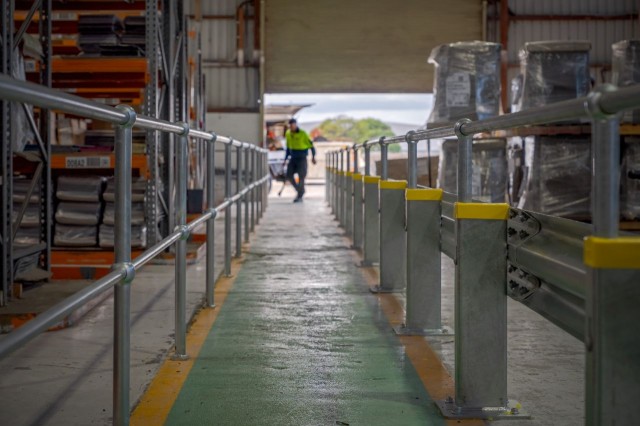
Metal Guardrails (e.g., W-Beam Guardrail, NoWeld & Ball Fence): Traditional metal guardrails remain a proven choice for withstanding heavy impacts in mixed pedestrian and forklift zones. Their rigidness upon impact brings the vehicle to a firm halt, preventing further damage to any assets on the other side.
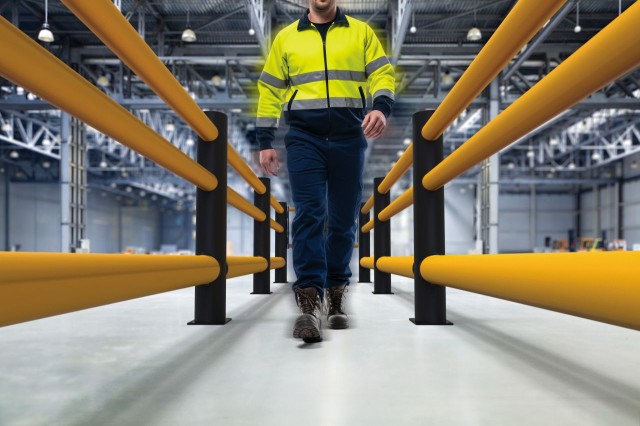
Polymer Barriers (e.g., FlexGuard™ Polymer Barrier): Energy-absorbing polymer barrier systems designed to absorb impact energy to reduce floor, vehicle, and barrier damage. Typically chosen for areas with frequent forklift activity and repeated impact risk.
In our experience working across industrial facilities of varying sizes and activity levels, zoning guardrail types to match risk profiles is the most effective approach.
If you need guidance on specifying the right guardrail system for your facility, contact Barrier Group. Our team of experts can help you specify for both compliance and true operational safety.
Contact Barrier Group on 1300 55 33 20 or submit an enquiry via our contact form for practical advice tailored to your facility.