

Temporary and Permanent Barriers: Considerations for Optimising Safety and Efficiency in Industrial Facilities

When evaluating temporary versus permanent barriers, the baseline consideration is whether the risk is predictable or dynamic. The nature of the risk should determine the type of protection installed - not convenience or habit.
When it comes to safety barriers, Johansen and Rausand (2015) outlined the core principles used in the offshore oil and gas sector – one of the most high-risk operational environments. They highlighted the importance of combining effective risk management processes with a mix of safety-barrier strategies to ensure a cohesive, proactive safety system.
It's common for industrial operators to assume that fixed barrier systems automatically satisfy long-term safety standards. However, in our experience as a turn-key safety solutions provider, when safety auditors or HSRs observe a combination of both temporary and permanent barriers in a facility, it reflects a more comprehensive and well-considered safety management approach.
The effectiveness of physical safety infrastructure can be reflected by how much the risk can be reduced by implementing a type of safety barrier. With this strategic approach, combining fixed and temporary barriers can significantly enhance operational safety. Permanent barriers provide essential, non-negotiable segregation along pedestrian walkways and forklift routes, while temporary barriers add flexibility, guiding traffic and supporting dynamic workflows. Together, they create a safer environment that allows the facility to operate more confidently, efficiently, and responsively.
This integrated and dynamic approach represents the evolution of industrial safety from reactive to proactive, from rigid to responsive.
Understanding Permanent and Temporary Barrier Systems in the Real-World
Permanent Barriers Offer Stability and Long-Term Control
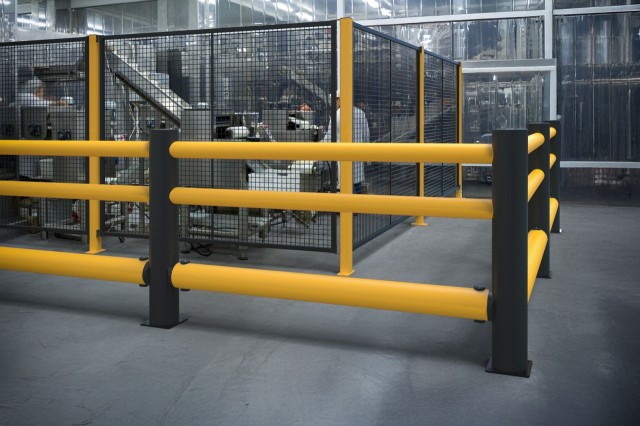
Permanent barriers take a reactive approach to safety and typically require a larger upfront investment but provide consistent, long-term protection in high-risk areas.
Real-world practical scenarios include:
Warehouse and Distribution Centres
In high-throughput warehouses and distribution centres, fixed barriers - such as metal and polymer guardrails, bollards, and industrial gates - provide essential segregation between pedestrians and vehicles while protecting assets and infrastructure. Strategically placed along traffic routes, aisles, and loading docks, these barriers reduce collision risks, support safe forklift operations, and help maintain industrial compliance.
Manufacturing Facilities and Factories
Fixed machine guarding, along with metal guardrail and polymer barriers, is widely used to protect assets and limit access to high-risk machinery. Permanently installed guardrails reduce reliance on procedural controls, support lockout and isolation practices, and provide predictable protection in continuous-operation environments - particularly where equipment and workflows run on constant schedules.
Processing and Industrial Chemical Plants
In processing and chemical facilities, guardrails and industrial safety fencing are essential for managing hazards, with polymer barriers being the preferred choice in highly corrosive environments. Permanently installed barriers establish clearly defined safety zones around critical assets and hazardous materials, helping maintain consistent compliance across all operating conditions.
Temporary Barriers Offer Flexibility
Temporary and removable safety barriers take a proactive approach to managing workplace behaviour in real time. By restricting access, redirecting movement, and clearly marking "no-go" zones, they give operators the flexibility to influence pedestrian and vehicle flow quickly and effectively. The real value of temporary barriers lies in their ability to adapt instantly to changing operational conditions while keeping workers safe.
Real-world practical scenarios include:
Blocking Access to Doorways and Aisles in Shopping Centres, Office Buildings and Residential Blocks
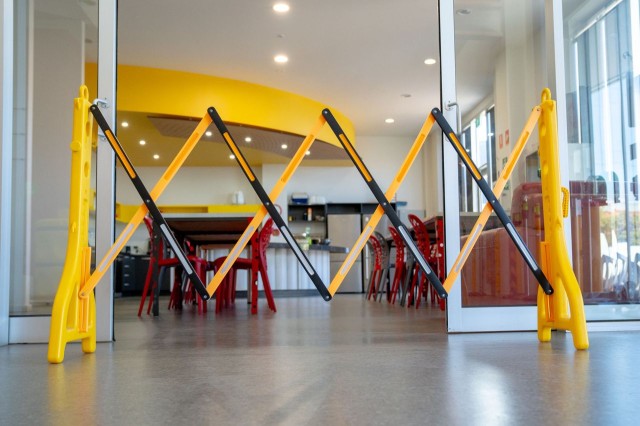
When areas need to be temporarily "out of service" due to maintenance, spills, equipment faults, or congestion, portable, expandable, or retractable barriers are commonly used to block doorways, aisles, and access points. These barriers provide an immediate, physical signal that access is restricted, reducing reliance on signage or verbal instructions alone. Once the hazard is addressed, the barriers can be quickly disassembled and redeployed wherever they are needed next.
Creating Temporary Exclusion Zones in Construction Sites and Outdoor Events
Short-term exclusion zone protection is best achieved using temporary/modular fencing and retractable barriers. These safety barriers enable users to set clear boundaries around active areas such as damaged infrastructure or spectator queuing areas at events, with the flexibility to adjust zone size and shape as conditions change.
Isolating Maintenance and Breakdown Areas
When machinery or utility units need inspection or repair, retractable belt barriers help quickly isolate the work area. They create a clear exclusion zone around forklifts, conveyors, pallet wrappers, or racking, reducing unauthorised access during maintenance without the need for permanent barriers.
Managing Dock and Loading Bay Activity in Warehouse and 3PL Facilities
Loading docks are dynamic, with vehicle and pedestrian movements changing daily. Temporary barriers close inactive doors, segregate pedestrians during loading, or create safe zones for drivers and staff.
How to Approach Layered Safety in Industrial Facilities
A multi-layered approach to safety starts with understanding the nature of risk.
The safest option is not always the easiest, and often multiple types of safety barriers, both fixed and temporary, come together to create a layered safety framework that adapts to your facility over time.
Here are some strategies to get started:
1. Apply flexibility alongside permanence
Fixed steel guardrails, polymer barriers, industrial safety fencing and gates form the backbone of industrial safety. Temporary barriers, retractable belt systems, and modular fencing complement these structures by addressing short-term risks, such as maintenance, high-traffic periods, or aisle reconfigurations, without requiring permanent changes.
2. Embed procedures and training from day
Despite their impact on operational continuity, physical safety barriers alone are not enough. Staff must understand when and how to respect both temporary and fixed systems. Regular training, clear signage, and documented procedures ensure the entire workforce can contribute to a safer industrial facility.
3. Track, evaluate, and refine
Safety is an ongoing system rather than a static configuration. Observing incidents, near-misses, and workflow patterns enables facility operators to evaluate the effectiveness of temporary measures alongside permanent infrastructure. Repeatedly refining deployment strategies ensures that risk controls expand in tandem with operational growth.
At Barrier Group, the focus is on designing fully integrated safety systems that hold up under real-world pressure, not just inspection. That means working with clients to understand how their sites actually operate and where both fixed and temporary barriers are best suited.