

Steel vs Polymer Bollards: A Zone-by-Zone Decision Framework

Metal and polymer bollards are engineered to perform in different impact environments. Steel bollards are designed to withstand/ resist single high-energy impacts, while polymer bollards absorb and recover from repeated low-energy impacts. Most industrial and commercial facilities require a combination of both. By matching bollard type to the risk profile of each area, organisations can achieve a more effective, durable, and cost-efficient safety outcome.
Where do Steel Bollards Belong?
Where do Polymer Bollards Belong?
Decision-Support Guide: Choosing Bollard Material by Zone
| If your zone is primarily... | Consider... | Because... |
|---|---|---|
| Static with high-energy infrequent impacts | Steel bollards | Designed to withstand significant single impacts. |
| Active with frequent forklift movement | Polymer bollards | Engineered to absorb and recover from repeated impacts. |
| Outdoor with direct UV exposure | Steel bollards | Suitable for prolonged UV exposure. |
| Wash-down or corrosive areas | Polymer bollards | Corrosion-resistant material. |
| Mixed-risk facility | Steel bollards & polymer bollards | Matching bollard type to the risk is a more effective, durable, and cost-efficient approach. |
A Hybrid Approach to Bollard Specification
In our experience working across industrial facilities of varying sizes and activity levels, zoning bollard types to match risk profiles is the most effective approach.
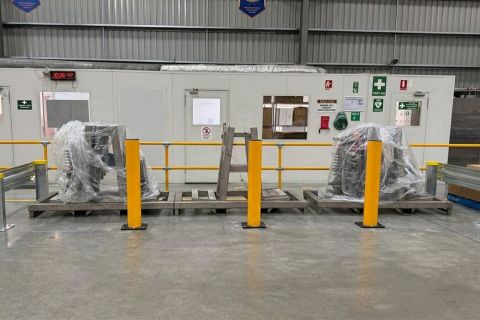
FlexGuard™ Bollards with NoWeld Handrail and W-Beam Guardrail: NoWeld Handrail provides clear pedestrian segregation, while W-Beam Guardrail creates a robust, enclosed storage area to protect critical assets. Strategically positioned FlexGuard™ Bollards absorb repeated impacts from forklifts, trolleys, and other material handling equipment operating adjacent to the enclosure.
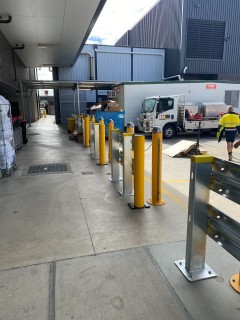
FlexGuard™ Bollards with W-Beam Guardrail: W-Beam Guardrail provides heavy-duty perimeter protection, while strategically positioned FlexGuard™ Bollards absorb repeated impacts from trolleys, pallet jacks, and other material handling equipment operating through access points. |
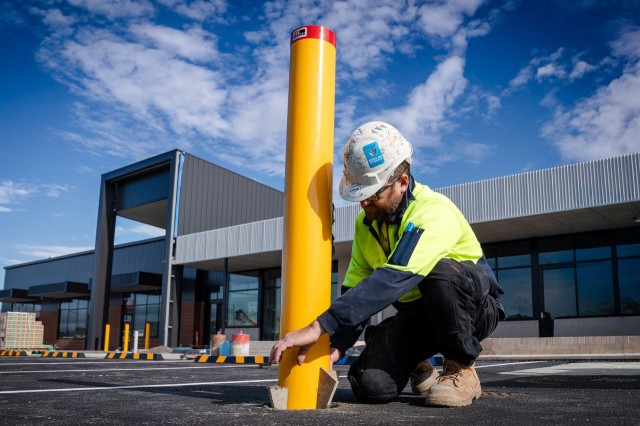
Conducting a Risk Assessment
Every specification decision should start with a zone risk assessment across three variables:
- Vehicle type and weight class;
- Operating speed within the zone; and
- Expected impact frequency.
If you need guidance on specifying the right bollard for your facility, contact Barrier Group. Our team of experts can help you specify for both compliance and true operational safety.
Contact Barrier Group on 1300 55 33 20 or submit an enquiry via our contact form for practical advice tailored to your facility.